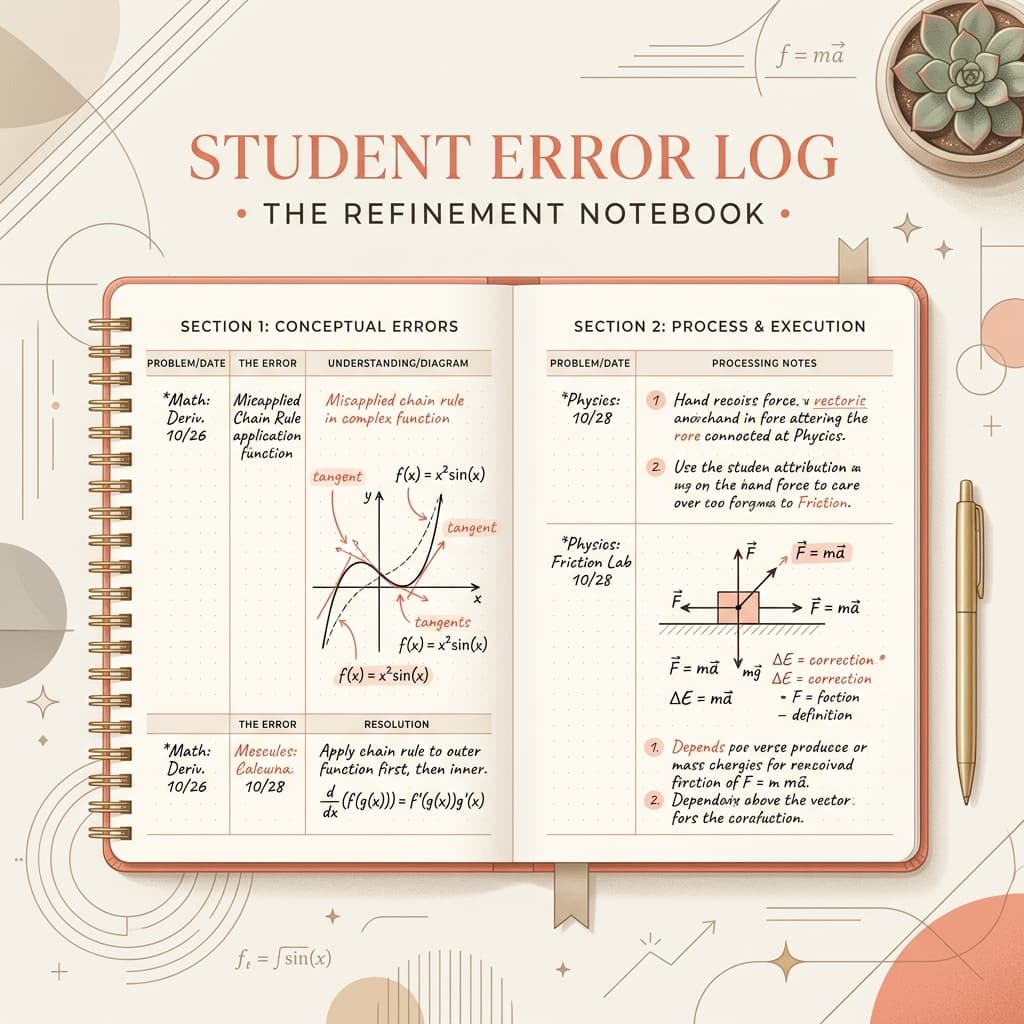
Study Strategy·8 Min Read
Building an Error Log That Actually Improves Your MCQ Scores
Effective error logs are short, searchable, and drive decisions. Avoid excessive detail to ensure long-term consistency and actionable insights.
Why Generic Mistake Notes Fail
Typical mistake notes are often abandoned within weeks because they lack structure. Understanding these four structural problems is the first step to building a log that works.
01
Entries take too long to write
Lengthy notes are often skipped. Consistency is key to spotting patterns across papers.
02
No consistent categories
Fixed categories reveal whether reading or concept errors dominate your performance.
03
No review schedule
A log is only useful if reviewed. Frequent comparisons reveal hidden patterns.
04
No next-action decision
Writing notes isn't enough; your log must drive behavioral changes in the next session.
The Minimal Template
Structure per Mistake
- Question reference
- Your answer & correct answer
- Error type (concept, method, reading, timing)
- One correction rule
- Status (new, reviewed, stable)
60s
The 60-Second Rule
If an entry takes more than 60 seconds to write, simplify it. Detail is the enemy of consistency.
The goal is a record short enough to maintain across every paper you sit.
Filled Example
Keep entries to a single line per field for maximum efficiency. Every field should be concise and actionable.
Error Entry #001
Reviewed
ReferencePhysics 0625 · Paper 12 · Q18
Answers
ByoursDcorrect
Error typeReading
Rule“Identify the quantity asked before comparing options”
Written in under 60 secondsEnough context to avoid repeating this mistake
ReferenceLets you locate the original question without flicking through the whole paper.
AnswersSeeing both at once reinforces which option was correct and why yours differed.
Error typeOne of four fixed labels. Enables pattern counting across sessions.
RuleOne sentence. The exact thought process change needed to avoid this next time.
Weekly Review Cadence
After Paper
5 minutes
- •Add new entries
- •Tag each by error type
- •Pick one repeated pattern
End of Week
10–15 minutes
- •Count repeated error types
- •Identify top two weak patterns
- •Assign next-week actions
Example: Concept errors → topical drill. Reading errors → slow-read set.
End of 2 Weeks
15 minutes
- •Compare current vs previous pattern counts
- •Retire stable entries
- •Keep high-risk patterns in active review
Decision Rules
Use rules to turn your log into action. These three thresholds cover most situations you will encounter during revision.
3+
Same pattern appears 3 or more times → schedule a targeted session within 48 hours1
Pattern appears once only → note and monitor across next two papers before actingStable for two weeks with zero recurrence → archive the entry and free up active review capacity
Using Your Error Log Across Subjects
Use your log across all subjects to identify cross-subject error patterns. Missing these signals means missing high-leverage training targets.
Reading errors often occur across multiple subjects. Sorting your log by error type reveals patterns that pay dividends across every paper you sit.
Subject-specific errors
Some mistakes only arise in one subject. Calculation translation errors (misreading units) tend to cluster in Physics and Chemistry. Handling these requires subject-specific drills.
Strategy: subject-tagged log entries, drilled per subject
Cross-subject errors
Reading errors and premature selection appear in every MCQ subject. One targeted slow-read session improves all of them simultaneously. These are your highest-leverage targets.
Strategy: sort log by error type, ignore subject tag
Practical step: After two weeks, sort all log entries by error type regardless of subject. Any type that appears in three or more subjects is your primary training target for the following week.
What Not To Do
- Writing long explanations you will not revisit.
- Mixing all mistake types into one generic label.
- Reviewing only before exams.
- Tracking volume instead of pattern frequency.
The Final Takeaway
The best error log is not the most detailed one. It is the one you can sustain and use to choose better next sessions.
Keep entries short, review weekly, and convert patterns into actions. That is where score gains come from.
Ready to log your mistakes?
Try taking a practice session and building your first error log entry.
Keep Building Your System
The Night Before Your IGCSE Exam: What To Do and What Not To Do
The twelve hours before your exam matter more than most students realise. Here is a practical, calm guide to your evening routine, what to avoid, and how to arrive ready.
How to Use Your QuickMark Reports Page to Plan Next Week's Revision
Stop guessing what to revise. Your QuickMark Reports page gives you a full breakdown of wrong answers, skipped questions, and weakest topics so you can plan next week with data instead of instinct.
How to Review MCQ Mark Schemes Efficiently After a Past Paper
Turn mark schemes into actionable revision: log what matters, spot recurring errors, and choose your next study session with a concrete 20-minute workflow.